
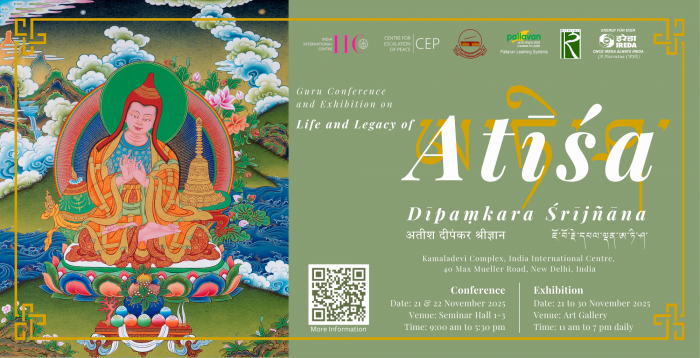
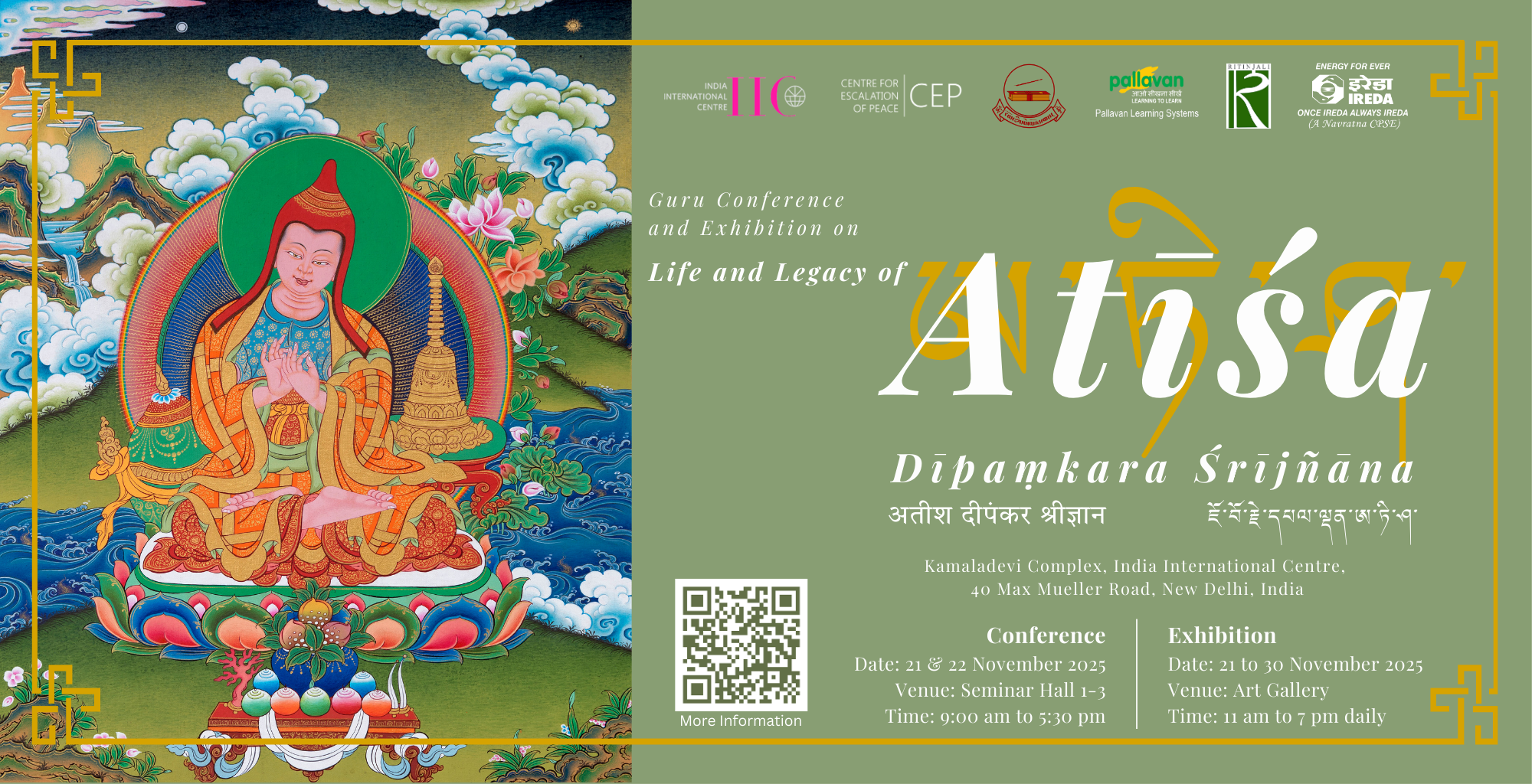
Guru Conference & Exhibition on Life and Legacy of Atīśa Dīpaṃkara Śrījñāna 2025
Building on the success of the 2019 Guru Conference, which focused on the Life and Legacy of Guru Padmasambhava, the Centre for Escalation of Peace and the India International Centre, in collaboration with the Library of Tibetan Works & Archives, Ritinjali, and Pallavan Learning Systems, presented a two-day conference dedicated to Atīśa Dīpaṃkara Śrījñāna, a luminary whose influence continues to shape the Buddhist tradition across Asia.
Atīśa Dīpaṃkara Śrījñāna, a towering figure in Buddhist history, is renowned for his intellectual and spiritual contributions that still resonate today. The conference explored his multifaceted roles as a scholar, reformer, spiritual leader, and cosmopolitan figure, celebrating his enduring legacy.
The conference began by examining Atīśa’s early life and intellectual journey, which laid the foundation for his significant contributions to Buddhism. Born in what is now Bangladesh, Atīśa’s rigorous scholarly training under distinguished teachers encompassed a wide array of Buddhist traditions—Theravāda, Mahāyāna, and Vajrayāna—as well as disciplines such as logic, astrology, and philosophy. His extensive travels across Asia, including time in India, Tibet, and Indonesia, enabled him to synthesise diverse strands of Buddhist thought. During this period, Atīśa also served as Abbot of the prestigious Vikramaśīla University, a role that not only cemented his academic reputation but also influenced his later contributions to Buddhist education and reform.
A key focus of the conference was Atīśa’s perilous journey to Indonesia, where he sought teachings on Bodhicitta from the master Dharmakīrti (Suvarṇadvipi Dharmarakṣita or Lama Serlingpa). This quest exemplified Atīśa’s dedication to obtaining profound teachings, which later played a crucial role in the development of Buddhism in Tibet, Bhutan and other Himalayan regions. The impact of this journey on Atīśa’s teachings and his role in bridging different Buddhist traditions was explored in depth.
Atīśa’s connection to Bhutan was highlighted through his influence on the development of Buddhism in the region. Although Atīśa himself did not visit Bhutan, his disciples and the teachings he disseminated significantly shaped the country’s religious landscape. Bhutanese Buddhism—particularly the Drukpa Kagyu and Nyingma schools—was influenced by his emphasis on ethical conduct, meditation practices, and the gradual path to enlightenment. Even today, Atīśa’s legacy continues to be honoured in Bhutan, where many of his texts and teachings are widely studied.
The conference also examined Atīśa’s contributions to the ethical and moral dimensions of Buddhism, particularly his emphasis on Vinaya (monastic discipline) and the guru–disciple relationship. His deep spiritual connections with his disciples were discussed, highlighting the profound authority he commanded as a spiritual leader.
Central to Atīśa’s legacy is his seminal work, Bodhipathapradīpa (“A Lamp for the Path to Enlightenment”), which remains foundational across all schools of Mahāyāna. The text’s comprehensive outline of the path to enlightenment, integrating both exoteric and esoteric teachings, served as a focal point, with discussions on its enduring relevance in the Himalayan region.
Although Atīśa is retrospectively recognised as the founder of the Kadam school, the conference also included a special session on guided meditation on Bodhicitta, which he practised rigorously. These methods, aimed at transforming the mind and cultivating compassion, were discussed for their historical significance and continued relevance in contemporary Buddhist practice.
The conference was complemented by an exhibition of relics, manuscripts, and photographs, offering a visual exploration of the cultural and artistic heritage associated with Atīśa Dīpaṃkara Śrījñāna.
The event served as a comprehensive scholarly examination of Atīśa Dīpaṃkara Śrījñāna’s life, teachings, and legacy. By bringing together academics, practitioners, and scholars, the conference celebrated his remarkable contributions to the spiritual and cultural heritage of Asia, ensuring that his profound wisdom continues to guide future generations.
" With mindfulness, vigilance, and conscientiousness,
Constantly guard the gateways of your senses.
Again and again, three times both day and night,
Examine the flow of your thoughts."
- Atisha, Verse 2 from The Bodhisattva’s Jewel Garland
Click here to view or download the Conference Report, and here to access the Exhibition Brochure. You can also find the root text of Bodhipathapradīpa (“A Lamp for the Path to Enlightenment”) here.
Click here to watch the recordings of the conference sessions.
To receive regular updates, subscribe to our Pallavan World and PLS Newsletter.
Should you have any feedback and suggestions, please feel free to share with us.